I build the invisible architecture that makes complexity feel effortless — from Cisco's global commerce ecosystem to AI-powered contact centers. Research first. Systems always. Outcomes always measurable.
Real products. Real users under real pressure. Every project began with research and ended with measurable outcomes. Click any card for the full story.
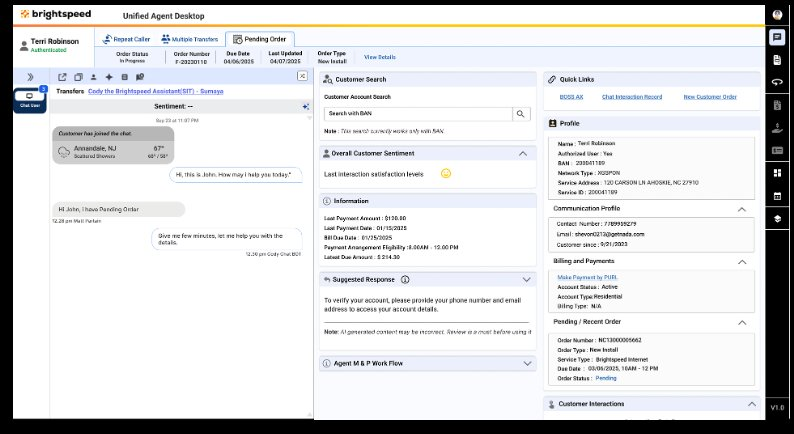
2,000+ contact center agents were navigating 5 disconnected tools during live customer calls — managing conversations while copy-pasting account numbers between tabs. Onboarding took 6+ weeks. Satisfaction scores sat at 52%.
Cisco's global B2B partners had no unified view of their API performance, order status, or subscription health. Partners made critical inventory decisions based on stale, fragmented data across completely separate systems.
Enterprise admins managing 113K+ Smart Accounts had zero unified visibility into license entitlement, consumption, and renewal status. Support tickets went unresolved for weeks — no one could trace a case across disconnected systems. The cost: measurable support overhead, delayed renewal revenue, and compounding design debt across 4 product cycles.

A structured, adaptive loop — not a waterfall. Click any stage to see what happens inside it, including real examples from the projects above.
Two decades sharpening every phase of the UX lifecycle — from strategy to delivery, research to systems thinking.
Design systems are shared agreements — not component libraries. I build for longevity: token-first, accessible, composition-based, living-documented.
--color-success can change to any hue in a theme update without breaking component meaning.My design career began in 2005 with a simple HTML/CSS website and a curiosity that never quieted. Over two decades, that curiosity took me from web design in Hyderabad to enterprise UX architecture embedded inside Cisco's global commerce teams — designing systems that thousands of administrators and millions of end users depend on every day.
What I've learned is that the most important design work happens before anyone opens Figma. It's the clarity of a shared mental model, the discipline of a governance process that travels across teams, and the trust built in rooms where design has to earn its place alongside engineering timelines and business roadmaps.
I'm drawn to complexity — not because it's impressive, but because making the complex feel simple is genuinely hard, and that difficulty is where the most meaningful design decisions live.
Design is infrastructure before it is aesthetics. A design system that travels, a research practice that informs product strategy, and a governance process that survives handoffs — these create more lasting value than any individual screen, no matter how beautifully crafted.
Open to senior design leadership, design practice building, and complex enterprise UX challenges. Let's talk about what you're trying to achieve.
The Pending Order modal consolidates what was previously in 3 separate systems. It shows order details, installation timeline, number porting status, DSL plan configuration, and the full 6-step order progress stepper — all in one glanceable view.
The KPI strip gives partners at-a-glance API performance across configurable time periods. The donut charts were tested in 3 distinct formats before the final pattern reduced misinterpretation of "unused" vs "dormant" APIs from 67% to 12% in testing.
Lead UX Designer — embedded within Cisco's Smart Licensing product team across 4 major product cycles (2013–2022). End-to-end ownership spanning UX strategy, information architecture, interaction design, design system governance, and post-launch measurement. I ran all research, owned IA and interaction design, and led design reviews with 15+ cross-functional stakeholders including engineering leads, product owners, finance, and compliance teams.
The critical research insight: users weren't confused by the data — they were confused by the absence of a shared vocabulary across teams. "Entitlement" meant different things to finance, provisioning, and support. Establishing a shared glossary became the prerequisite to any interface design — and that glossary, documented as part of the design system, outlasted multiple product cycles.
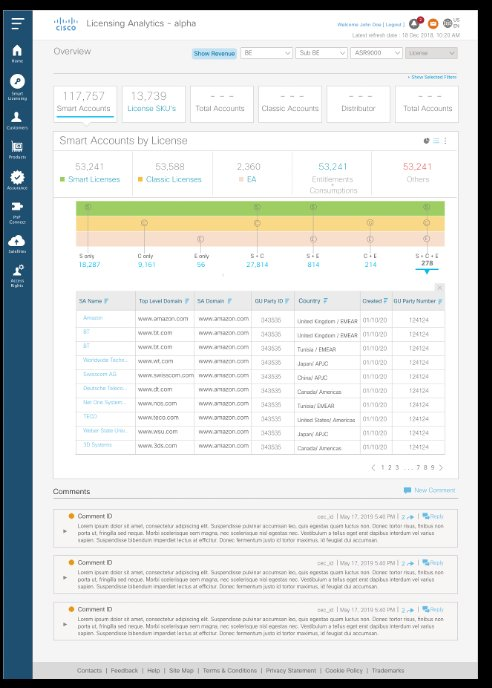
The Smart Accounts by License view — one of the most complex IA challenges in the project. 53,241 smart accounts needed to be navigable by license type (Smart, Classic, EA), entitlement consumptions, and distributor hierarchy simultaneously. The stacked bar visualization and filterable table emerged from 6 rounds of co-design sessions with actual Cisco account managers and SA admins across Americas, EMEAR, and APJC theaters.
The Products analytics view unified three previously disconnected data streams — Ordered (2,039 Smart / 1,019 Hybrid / 3,139 Classic), Entitled, and Consumed — into one coherent lifecycle view. The Smart/Hybrid/Classic donut charts and the tabbed filter (All / Smart / Classic / Hybrid) were validated through 8 usability tests with Cisco partner administrators across 4 geographies. The product table with Purchased vs Consumption columns directly replaced a 47-minute-per-week manual spreadsheet process.
A 9-year embedded engagement creates design advantages that project-based work cannot. I understood organizational dependencies, political dynamics around system integration, and Cisco's platform architecture at a level that let me propose solutions others couldn't — because I knew which constraints were real and which were negotiable.
The Smart Licensing redesign was the fourth major iteration I led, each informed by longitudinal research with the same user populations and genuine understanding of how their needs had evolved over time. The Comments module (built for collaborative case resolution) emerged directly from observation of how account managers were working around the lack of a shared notes system — using email threads to track pending issues.